ラベル curiosity の投稿を表示しています。 すべての投稿を表示

水曜日, 5月 26, 2010

Photo Tokyo


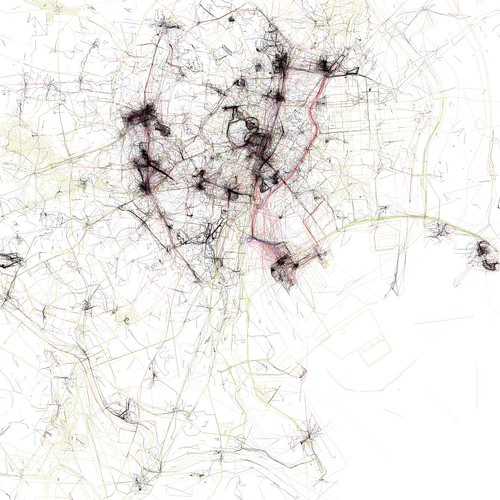
Incredible visualisation of Tokyo based on the numbers of photos taken at a point. I suspect that it this is massively underestimating the number of photos because the websites providing the data (Flickr, Picasa) are American, with an Anglo-Saxon bias.

土曜日, 8月 18, 2007

The sound of gibberish

The strange thing about the way language works is that everyone else has an accent except me.

The natural tendency is to look upon everyone else's variations from my normal as being the odd bit. What's equally fascinating is that for a large part of it, it is simply the sound that makes things different.

Here a guy called Crehnquist tries his hand at sounding like he is speaking a few foreign languages, including Japanese (thanks to Carlie who put me on to this one).


I think he does a remarkably good job, and though of course my familiarity with Japanese means I spot the sounds and words that are wrong, if I wasn't paying attention and I heard this in the background, I probably would have mistaken it for the real thing.

The responses are mixed and frankly they mostly seem to miss the point, but for this guy, a German who's voice sounds, if you tune out, just like a CNN newscast (actually, one of the responses says BBC but he is clearly too animated for the BBC who are more neutral sounding than this).

The important thing we should take from this as students of language is that if you want to speak a language there is so much more to doing it properly than simply learning the words and the grammar - you really need to listen to the sound.

Anyone who has taught English in Japan will understand the impact of a student who, after you've spent hours teaching kids and housewives who maybe have never been abroad or used English in anger, wanders in and starts communicating in accented Californian or Australian English. You almost wonder what they are doing there.

Personally, when I am thinking about my Japanese I always try to speak from the back of my throat and barely move my lips, like the monosyllabic grunts of Samurai films. Of course, for girls you have to do that whole trill screechy thing. Well, it's never easy is it?

金曜日, 7月 06, 2007

Commercial de ja vous

When you go anywhere or do anything in Japan you get this strange feeling of "seen that before" whenever you look at ANYTHING. Seriously. The same names crop up time and time again. It's not that there aren't many names in Japan mind you - it just probably is the same name.

A zaibatsu was an single company that covered many fields. They sprang up, for the most part, during the peace of the Tokugawa period (1600-1853). These entities became enormous and a handful dominated the Japanese economy.

They were dismantled by the occupation powers following the occupation of Japan after the war, but they reappeared as a cluster of smaller companies still bearing the same name of their parent companies, usually sharing a common bank. The crucial factor in this is that all the companies tend to own shares in one another and so still share a common bond. They might even integrate themselves in a supply chain, so the mining company supplies the smelting company supplies the materials to the manufacturer. In other cases, individual parts may have gone independant in legal terms, but they still share a common heritage.

Sumitomo, a name still recognisable on the streets of Japan is a typical example. Founded in 1630 as a shop selling medicines and books, it branched out in to metallurgy (naturally) and nowadays, as a keiretsu, can be found in forestry, mining, armaments, consumer electronics and, of course, banking.

Here are the main players, their banks and a few of their headline brands:
Mitsubishi
Bank of Tokyo-Mitsubishi UFJ
Mitsubishi Corporation, Kirin Brewery, Mitsubishi Electric, Mitsubishi Fuso, Mitsubishi Motors, Nippon Yusen, Shin-Nippon Petroleum, Tokio Marine and Fire Insurance, Nikon

Mitsui
Sumitomo Mitsui Bank
Fuji Photo Film, Mitsui Real Estate, Mitsukoshi, Suntory, Toshiba, Toyota

Sumitomo
Sumitomo Mitsui Bank
Asahi Breweries, Hanshin Railway, Keihan Railway, Mazda, Nankai Railway, NEC, Sumitomo Real Estate

Fuyo
Mizuho Bank
Canon, Hitachi, Marubeni, Matsuya, Nissan, Ricoh, Tobu Railway, Yamaha

Dai-Ichi Kangyo
Mizuho Bank
Fujitsu, Hitachi, Isuzu, Itochu, Tokyo Electric Power

Sanwa ("Midorikai")
Bank of Tokyo-Mitsubishi UFJ
Hankyu Railway, Keisei Railway, Kobe Steel, Konica Minolta, Kyocera, Orix, Shin-Maywa, Takashimaya, Toho
I must stress, the zaibatsu do not necessarily OWN the companies in the family, but they may still have close ties and more than likely a mutual shared ownership of shares. The leaders may get together to bond from time to time. In the case of Sumitomo, for example, it is said that they still all obey the rules laid out by the founder 350 years ago.

Another interesting feature of all this is that the people who worked for these companies would follow the line. So, again using Sumitomo as an example, if you were a worker for NEC (you assembled stereos), you might ride to work on the Keihan railway, living in a commuter town on that line build largely by Sumitomo real estate. You would bank with Sumitomo, who may have lent you the money to buy your Mazda and when you get home in the evening you would be most likely to unwind with a nice Asahi.

Sounds a bit fuedal really.

水曜日, 5月 16, 2007

The ドラえもん conundrum.

Why is Doraemon spelt like that?

ドラえもん

Notice that? The name uses both katakana and hiragana. If you don't read kana, notice how the first two characters are angular, the other three more rounded.

Weird. My local expert hasn't a clue. Any suggestions?

土曜日, 4月 28, 2007

Days of the week

One of the great curios of learning Japanese, for me at least, was the similarity in the naming of the days of the week in Japanese and English:
日曜日(nichi-youbi) literally translates as sun-day
月曜日(getsu-youbi) is moon-day, or Monday
(the bi bit is the part used for sun, one sun being a day, naturally)

I couldn't understand how this might have occurred unless by Japan adopting new names for the days of the week, and presumably a western style seven day week along with all the other things it took up during Meiji.

Well, as it happens the story is more interesting. The Japanese calendar is, surprise surprise, based on the Chinese calendar. The Chinese calendar is itself the product of a Babylonian influence on pretty much the whole world. The Babylonian seven day week, probably born from the 28 day lunar cycle and the need by early agrarian societies to meet to trade, was named after the seven bodies in the sky that were visible, ie the sun, moon and five planets.

In English this got corrupted as certain days of the week were re-associated with Norse gods, for example Thursday = Thor's Day, Friday = Freya's Day; but the sun and moon remained.

In Japanese, from Chinese, the relationships for the rest of the week are:
火曜日 (ka-youbi) or fire-day = Tuesday
水曜日 (sui) or water-day = Wednesday
木曜日 (moku) or wood-day = Thursday
金曜日 (kin) or metal/gold-day = Friday
土曜日 (do) or earth-day = Saturday

The observant might spot that these relationships are like the elements, and that's about it; in Chinese mythology the planets are associated with elements - for example the planet Saturn is associated with the element earth. Which is, lo and behold, found to be doyoubi, or Saturn's Day = Saturday.

On a related note, in written form the days in Japanese usually omit the you bit of the days of the week, so 土日、日日 etc would be common. This 曜(you) bit is a little odd as while in Japanese its use is limited to the meaning discussed here, in Chinese it means 'pretty bird' or something along those lines.

NOTE: this is predominantly pieced together from Wikipedia (here and here), which as we all know is an entirely unreliable source, but as the facts seem to hold together from various entries, and bare out a logical consideration of the facts, I'm content that in this instance it seems reasonable.