水曜日, 10月 15, 2008

Got Anki?

Ooh, joy of joys, another Anki update! As it creeps its way inexorably toward a v1 release, here is what Anki looks like 0.0.1.7 of its development to go:I'm a big fan. After years of trying to learn vocab and failing, Anki REALLY, finally, seems to be making a bit of a difference. As I spend more time trying - hopelessly for the most part - to chat in Japanese at home, I snatch bits of language and stuff them in to Anki. Slowly I'm getting to the point where I remember those bits the next time I need to use them. Knee. 膝。ひざ。See? Working already.

Why is Anki so good? Because it is based on spaced repetition - probably one of the most significant points of research supported understanding in learning theory, and yet one of the most under used.

As my son gets older I'm going to be encouraging him to use one to support his learning (perhaps I should work out about the sounds now). Who knows, he may even get to work with version one!

木曜日, 10月 02, 2008

N700系 「のぞみ」

Well, for some time I've been meaning to do a series on the shinkansen, or 'bullet' trains, in my son's スーパーのりものシリーズ (super vehicles) book, しんかんせん. So today we start with the first and foremost, the mightly N700.

東京えき~博多駅(福岡)の間を走っています。最高速度は時速300km。お客さんを乗せて、日本で一番速いスピードで走れるのが自慢の新幹線です。カーブを曲がる時でも スピードを落とさず、少ない揺れで上手に曲がることができます。
Right then, what does this mean? Here's what I think...
The train runs between Tokyo and Hakata in Fukuoka Prefecture. Its top speed is 300km/h. [Gets a bit trickier now, but something like...]Customers can take pride in riding the fastest bullet train in Japan. The train leans in to corners so it doesn't have to slow down, [and I'm paraphrasing the next bit] it corners without wobbling.
Of course, I may well (ie am) some way off with this translation, so feel free to correct me or add anything you think may be useful.

Key words :

  • 走っている (はしっている)= running - literally "running", just like with a pair of Nikes. Odd that it is the same turn of phrase in Japanese as it is in English - speakers of many European would screw up their faces if you used that, after all, trains don't have legs.
  • 最高速度 (さいこうそくど)= top speed - that phrase again "さいこう"(in romaji, "saikou"), meaning top, best, excellent.
  • 落とさず (おとさず) = is, I think, something like "without reducing", but I can't be sure since I can't find it in my books. However, the root verb 落ちる is also useful in the sense of dropping (a ball for example) or failing (a language exam for example).
About the train
This bizarre looking duck faced train is the quickest in Japan, and for some time was the fasted in the world. It is a 'nozomi' which is the fastest, least stoppingest type of shinkansen around. Inside the seats are in groups of three, either side of the wide aisle, which makes this train very much wider than a UK train.

水曜日, 10月 01, 2008

Coming soon:スーパーのりものシリーズしんかんせん

I've found a great book about one of Japan's best features - its trains. I'm going to share it with you, but first, here's a taster of what to expect...

N700形 のぞみ
東京駅~博多駅(福岡)の間を走っています。最高速度は時速300km。お客さんを乗せて、日本で一番速いスピードで走れるのが自慢の新幹線です。

Thrilling stuff, I'm sure you'll agree.

日曜日, 8月 10, 2008

Funky housing - I want one

With the housing market in the UK in freefall, domestic energy prices surging through the roof and there being something of a shortage of affordable housing, what the country needs is something cheap, quick to build, cost effective to heat and frankly different to the myriad of dull city apartment blocks.

How about these?


Okay, these incredible polystyrene domes from the aptly named International Dome Houses company of Japan don't quite meet the ideal requirements for housing density that would be the most perfect "green" solution (ground level living is, I'm afraid, inherently un-environmentally friendly in a small, crowded place like Southern England), but they check the box on just about every other score.


They cost around £15-20,000 in Japan, then you'd have to pay import duty, but that's not bad. A variety of pieces mean you can come up with variations on the dome theme too. And how damn cool are they to look at?

Image nicked from the unknowing, but quite skilled Erika Snyder. Story spotted on OtakuInternational.

木曜日, 8月 07, 2008

Take an idea - make it smaller

For many years it the received wisdom about Japanese industrial "innovation" that really all Japan was any good at was taking Western products and making them smaller (and later rather better) than their Western rivals. It was true of their bikes, consumer electronics and even cars.

That was a long time ago now, and genuine innovation in many areas (hybrid vehicles, Wii and BrainTraining), and remarkable abilities to miss entire markets repeatedly (can ANY Japanese manufacturer manage an MP3 player that isn't a dull "me-too" clone?) have buried that notion.

So its a breathtaking return to form that sees Toyota, in cahoots with Sony, produce these fantastic mini-Segways.


For me, the problem with Segways was always that the massive bulky shape of the chic uber-scooter was clearly the product of a mind that was oblivious to public transport.

Imagine trying to use a Segway to cruise three miles up hill and down dale across a city like Bristol. In late Autumn. In the rain. Not going to happen for so many reasons.

But if I could throw it in the luggage rack on the train, or as long as I could be sure no nutters would sit next to me, on the bus, then use it just at either end - exactly as the designers at Toyota would no doubt be thinking, then we have a winner. Brilliant.

Thanks to Mari for bringing this one to my attention.

火曜日, 8月 05, 2008

Green village on Shikoku

Just flitting through a bunch of tabs on my reader I found this interesting photo story about Kamikatsu, a small village in the hills of Shikoku that is attempting to go entirely sustainable - eliminating the need for landfill and recycling or reusing everything.

This is serious recycling - none of that "we don't take anything other than type 1 or 2 plastics and you deal with your own plastic bags" attitude here. There are 34 categories to sort your stuff in to!


This kind of initiative seems to the sort of thing that the village structure of Japan can facilitate. From what I read they seem to be much more self-governing, still running on models that Edo-era villagers would recognise. By contrast, my own experience of a village in Shropshire, in the rural hinterland of the English/Welsh border was of a place where you knew one or two families with kids your own age and no-one else had anything to do with each other. You'd never rustle up this kind of cooperation there.

土曜日, 8月 02, 2008

Time to buckle down (127 days to go)

The season for JLPT applications is nearly upon us. The notification on my phone to alert me on the first day that SOAS are ready to receive my carefully completed, practised and triplicated exercise in bureaucracy is just itching to send my ケイタイ in to frenzy of eager buzzing and ringing. (Seriously, check that first link - never has the JLPT looked so forbidding and sexy in one go!)

Having faffed and fiddled so much that I failed to get my MSc off the ground this year, I'm left with a yawning chasm in my learnability so I am prepared to send this this exercise properly this year.

So it was that I came back to Anki, the marvellous little app that earlier this year did so much for my vocab. And boy, was it keen to seen me. I've had a little session just now, but you can see from the graph how much I've had to make up, and I will still have to make up over the next couple of weeks, just to get things back to where they were...My lapsed time has left me with a mountain of cards to climb over. All the cards shown to the left of the spike are ones that have been missed - some by more than three weeks! Still, it is easy enough to put a couple of sessions a day to pick this up. Answering them once isn't the end of it of course, some will be postponed quite a distance, but I will fail a fair percentage of these and they will then reappear early in the cycle, making things quite heavy going for at least a couple of weeks.

My future profile at present makes for fun viewing...
The gradient shows a steep relearning curve. The line shows how many cards I would have on that day if I didn't study until then. Despite my efforts this morning, if I don't log on again until Thursday I would quickly be back at 150 cards. Better not slack this time.

火曜日, 7月 29, 2008

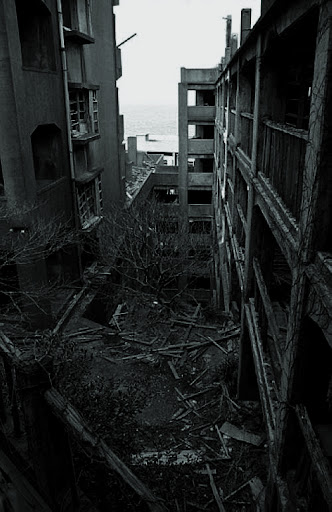
Japan Tourism - Battleship Island

I love Japan - it forever gives up new secrets. Look at this...


Hashima is an abandoned island to the west of Nagasaki that earned the forbidding moniker "Gunkanjiima" or Battleship Island, and you can clearly see how it got that.

Built by Mitsubishi, starting in the 1890s and continuing well into the 20th century, Hashima was reclaimed from the sea with the goal of extracting coal from the sea floor. I can only imagine what an horrific job that must have been, given that the whole enterprise began right in the earliest period of the undersea business.


The island was occupied as late as the early 1970s, earning the dubious distinction of being the most crowded place on earth - having seen just how tightly packed some of the older streets in Tokyo are one can only imagine what an even more densely fitted population must have been like.

If it looks hellish, that's not a thought that has escaped other observers. It has been the backdrop to movies and the inspiration behind video games.

Currently there is a ban on tourism to the island, though I gather there is a movement to try to open it up to visitors.

Thanks to this post at MutantFrog for leading me to this one at Odee.

Check out these images from Picasa.

土曜日, 5月 31, 2008

re イギリス, An apology to my students, friends and family

Dear all,
It is with my hat in my hand that I come to humbly beg your forgiveness for the way in which I have "set you straight" vis-a-vis the misleading, and for our friends in Scotland, Wales and Northern Ireland, slightly offensive moniker that your language takes for my home country, the United Kingdom of Great Britain and Northern Ireland.
As you will doubtless remember, where you may have mentioned the name of my country, or where I have regaled you with tales of growing up in the border marches and lost weekends among the mountains of Snowdonia, I will have probably set aside no few lungfuls to explain the misconception that seems to occur in the name イギリス (Igirisu) and its similarity to the word English, thereon pointing out that the English are native only to England, only one, though the largest and most populous, of the four home nations.
While I will stand by my discussion of the derivation of the word - as far as I know イギリス is a peculiarity in an otherwise accurate list of nations in approximations to their native tongue, フランス、ドイツ、イタリア and so on - I hereby retract the implication that it is somehow the fault of poor Japanese translation.
Whilst watching the excellent British TV show "QI", hosted by the brilliant Stephen Fry, it transpired that England and English were, up until about the 1930s and the development of Scots nationalism, used interchangeably with the name of the greater nation. Indeed, some prime ministers even went as far as to sign their names as "Prime Minister of England" when they meant the whole country.
So, for a friendly nation that so fastidiously takes efforts to use a nation's own pronunciation of its name, rather than simply changing it to fit one's own tongue ("Spain"), or making up a new name ("Burma"), or indeed just making a whole new country ("Iraq"), Japan should instead be applauded for its efforts.
I hope you can accept my apologies.
Dan

木曜日, 5月 08, 2008

Testing LiveWriter

I've spent a lot of time working away from the internet and often think of things then. So here is a great way to do things.

日曜日, 4月 13, 2008

Laying tracks to learning kanji

Studying kanji is not an easy activity outside Japan. The only appearance of the characters is within the confines of the study arena - there is no incidental reinforcement by the appearance around you that you get studying a language in it's own county, for example on TV or in on-train advertising.

When studying the kanji in isolation for it's basic meaning, as I do when consciously trying to learn new kanji, I find the meaning and the standalone 'kun-yomi' reading tend to stick more readily than the various compound 'on-yomi' readings. I would imagine this is because in many cases, because of my limited number of total kanji, many of the compound meanings are quite difficult for me as I may not know the other kanji in the compound. Without a mental 'hook' upon which to hang the new word, it falls away.

However, for me, one of the most noticeable improvements in my Japanese comprehension each time I return to Japan is that I can read more and more signs on the station maps; I can both find my way around the maps more quickly (now sometimes more quickly than my wife too!) and I get a feeling for the name's meaning. This has a knock on effect as I learn more on-yomi, or compound readings, for each character. Crucially, this also means that I have a 'hook' upon which to hang more new meanings. Since I know the whole word from navigating the rail lines, and I know some of the kanji, I remember the pronunciation of otherwise unknown kanji.

Take for example 上野 (うえの or Ueno). 上野 is the terminal station for the Joban Line in to Tokyo, and a major station on the Yamanote Line that rings Tokyo. The first character in the title, 上, is one that you learn very early on and means 'up/above'. The second character, 野, is one I don't know yet, but which JDic tells me means 'field'. So I now know 上野 roughly translates as 'upper fields' which is consistent as it atop a small hill I guess.

A second example would be with the even better known 東京, a little place you may have heard of, known in English as Tokyo. The first character here, 東, means 'East', but on its own is pronounced ひがし or 'higashi'. It frequently appears as this as often a town/area has more than one station and the location is often the way to distinguish them: see Nishi-Funabashi, Funabashi and Higashi-Funabashi stations on the Chuo/Sobu Line for example (West-Funabashi, Funabashi and East-Funabashi respectively). In the case of 東, getting familiar with the compound pronunciation, とう or 'tou' is useful, and opens the way to further understanding - for example getting to realise that the 'Touhoku' region the guidebooks refer to is simply 東北, or 'East North'.

Of course, you may make all these connections yourself during your study. But equally, like me, you may find that being presented with more contexts for the isolated characters presents ever more ways of creating the links and meanings to help secure understanding.

And it goes without saying that learning the names of train stations does have an additional and more direct benefit beyond learning kanji - you can just get around more easily.

With these learning and practical values in mind, I have started to create flashcards for stations around Tokyo at Flashcard Exchange, one of the better generic study tools I have found on the web. I like Flashcard Exchange because it allows you, after making a small one-off payment, to deploy the Leitner system, a methodical approach to flash card study that focuses effort where it is needed, using the idea of spaced repetition to help move new knowledge in to long term memory.

So far I've managed just the Yamanote Line, but I think I'll try to add some the other JR and Metro lines when I get the chance.

土曜日, 4月 12, 2008

Tadaima!

Well, our two weeks are at an all to swift end. Yesterday's marathon journey home, started at 7.30am Japan time, saw us get back safe and sound just short of 24 hours later.

We had a blast, and it opened our eyes to a few things I think. We'll be working on some changes for a few months yet, but I'll speak more on that later. So, what did we get up to? Here's a quick run down of what we did and what I may get to write about over the next couple of weeks:
  1. 木曜日 Arrived and whisked straight away to Anderson Kouen(アンダーサン亜公園), near Funabashi(船橋) for a day out.
  2. 金曜日 Visited Kashiwa and a few of the old haunts.
  3. 土曜日 Travelled to Shizuoka with K's dad to visit his mother, T's great-grandmother. Got a round of karaoke in.
  4. 日曜日 Shizuoka fish market, an abortive attempt to visit a frisbee shop, return to Kashiwa and a lost night with a couple of engineers I met while watching Reysol get defeated. 
  5. 月曜日 Returned home in shame. Finally got back out the house to meet my friend Mikako, her lovely new baby daughter and Eiko (a lady who was once my student, but later an employee of the Eikaiwa (英会話)I used to work for). Made the visit to that frisbee shop. Cool.
  6. 火曜日 I headed in to town to meet my old friend Duncan for hanami in Ueno park, then we met Gwilym and Dave. I later met some old girls from Shane, Akiko and Takako.
  7. 水曜日 While the others visited Tokyo Disney I walked the north half of the Yamanote Line (山の手線)the circular overground railway that links many of the major stations in Tokyo) from Ueno (上野) to Shibuya(渋谷. Along and interesting day.
  8. 木曜日 A quick visit to Nagareyama-otakanomori, a new local station on the all new Tsukuba Express rail line, and a great new shopping centre.
  9. 金曜日 Visited Asakusa, the traditionally working-class part of east Tokyo where a major shrine for Tokyo-ites is located, this time using the brilliant Tsukuba express.
  10. 土曜日Travelled down to Yokohama(横浜) to meet Toru, a former student, and his new son. I raced back to go to yakiniku with the family.
  11. 日曜日 Travelled to Hakone (箱根), a beautiful National Park south-west of Tokyo, famous for it's onsen, or natural spring baths.
  12. 月曜日 Returned from Hakone.
  13. 火曜日 I took a trip to Minami-Kashiwa(南柏), my old home station. Things have changed a lot. I wandered past my old apaato and then walked to another station through the suburbs, just for the vibes. great.
  14. 水曜日 Popped in to Akasaka for a chat with some important people, then an old study buddy in Ichigaya (市ヶ谷) who edits a science journal in Tokyo, before a trip to an izakaya with a friend near an old school of mine.
  15. 木曜日 Quiet day around Sakasai(逆井) and Kashiwa as it was raining, getting gifts, but did visit a great izakaya in Sakasai.
  16. 金曜日 The epic journey home.
A great trip, documented with loads of pics and video that I will be putting up over the next couple of weeks.

木曜日, 3月 06, 2008

Better luck next time?

So the result is in. And the word is not good.


45.25% Hardly my finest hour.

However, it's not all bad. Check out that best result! Listening. WTF?! That was the one I was most concerned about. And 65 is a pass. It's just a shame the rest of the scores were so damn bad.

So, I'm back on the vocab trail trying to work on the words that caused me a problem trying to read the last time round. Sure, that was the plan last time round, but I'm well pleased to realise that the tricky bit wasn't so bad.

To help things go better, I'm going to make a point of picking up a few of the old exam paper books while in Japan. With the exchange rate they should be less than half the price they are in the UK. Huzzah!

木曜日, 2月 14, 2008

Cripes - practice now necessary!

At last, we're going back to Japan!

For me it's been four years, and K and T haven't been back for nearly two. We will be rocking Chiba from 26 March to 11 April and frankly I'm having doubts that just over two weeks will be anything like long enough.

Cool journey has been arranged - we're flying from Bristol! Ahem, obviously not directly, but we have a fairly short stop over in gay Paris, then on to Narita. This should make the whole trip reasonably bearable - waiting at Bristol is not as long and getting out really is easier. The connecting flight is on a turbo-prop too, which I think is a first for me.

Activities on the list so far include:
  • get in a trip to Hakone for the three of us, and visit onsen
  • wallow at the local bath house
  • visit O-Edo Onsen again coz it's dead cool
  • visit K's grandmother in Shizuoka (by shinkansen, yeah!)
  • drink in Annabelle's in Kashiwa
  • ride on the new railway near Kashiwa
  • watch a Reysol game (maybe in a bar will suffice)
  • go to Tokyo Disney (or maybe I'll duck out of this one)
And I have to meet up with:
  • Duncan and Yuri
  • Tony (over in Kanazawa - yikes!)
  • Toru
  • Done-san
  • Ollie and Naoko
  • Gwilym
  • the Kashiwa area Shane folk
  • and more besides
I seriously cannot wait to go. I wanna go now dammit!

木曜日, 1月 03, 2008

Owning up

I went quiet. Want to know why?
I think I messed up.
I didn't study hard enough, and it really didn't need too much...
On the plus side, I can reuse all the textbooks I have bought over the last few years.
Let's go again...

水曜日, 11月 07, 2007

More channels for Kanji learning

Spend all your time online hanging out with friends on social networking sites?

Think about nothing but how you going to express yourself in your next Facebook update?

Sounds like you might work in the news centre at the BBC, but equally, if you're in to learning Japanese then you may finally have a legitimate reason for spending time loitering on fb:

Kanji Box

Following a run of checking these things out, Kanji Box is an interesting addition to the pack. A fb app that actually manages to do something meaningful, it offers all the jouyou kanji, cut and sliced two ways - by school grade or JLPT. You can review or test yourself on the characters and, and perhaps this is the killer part of this app, you can review your score results online against your fb buddies.

In addition it offers vocab (something I'm criminally weak on) and kana - great if you are just getting started.

The testing app is okay - you choose the correct answer from four options (but I'm not sure that this is self-defeating as this means that guessing becomes legitimated) and you have a clock to go against. There is no faulting the material either as the code-ninja that pulled it together is hauling on the venerable J-Dic of Jim Breen. Truly the Nihongo-phile portion of the Internet would collapse without that man around.

I like this, because unless we are as focussed on our results as Carlie, who blogs her progress on Reviewing the Kanji, Japanese study can be quite an insular process. Bringing learning apps to fb offers an interesting, and hitherto unexplored angle to things.

However, that same blog has also brought to my attention another spaced learning tool, which comes with a Japanese focus, but excitingly is also ostensibly for what ever you choose:

Anki

I've not got so much to say about this one as it appears to be a commercial app, but Anki looks pretty sweet.

It's another tool that draws on the spaced learning ideas of Sebastian Leitner. Like I say, although this is a tool designed to work with what ever you wish to add, it comes preconfigured with Japanese content. It looks really clean and nice, which is a bonus in a field that can sometimes look a bit homebaked. What makes it stand out for me are the impressive reporting stats and graphs, and the sophistication of the spacing element.

Anki is available for Windows, Mac and Debian Linux. Check out the screenshots for a bit more about how it all goes together.

I'm not in the market for such a thing right now as my kanji needs are being met by Reviewing the Kanji, and now Kanji Box, but if I find a learning need that could draw on Leitner as precisely as kanji learning does, I think I know where I'll be looking.

木曜日, 10月 25, 2007

An approach based on sound practice

By profession I create learning material - in fact one of the key reasons for having this blog is to put in to practice one of my firmly held beliefs (born out of reading the literature, rather than simply because I believe it). A few approaches that I would always bear in mind when creating material:
  • it is important not to create cognitive overload by trying to learn too many things simultaneously
  • breaking things in to chunks helps us manage our learning
  • spaced repetition is the key to long term memory creation
  • taking in information can be assisted by using prior knowledge as a building block
Of course, brute application of the type Tony at English Alien has been showing will work, but as a learning designer I'm aware that certain approaches can make the whole process easier.

I have some practical experience of this as it relates to the study of Japanese. What was most striking about my last trip to Japan was home much more intelligible everything was.

In the period since I'd lived in Japan I had actually been studying Japanese - something I hadn't done a great deal at the time as I hadn't really intended to remain connected to the country forever. Subsequently, getting on trains, walking the streets or looking at things to buy, the strange squiggles, markings and etchings that had silently passed me by the first time suddenly began talking to me. With a hundred or so kanji under my belt everything seemed to make a little more sense. I had a hook upon which to hang a few words and with that I was able to unlock vastly more than I knew, simply because the few that I knew gave me a lever on the possible pronunciation.

That said, it recently occurred to me that if I was to get through the remaining 三級漢字 for the test I would need to find a different approach: trying to learn the strokes, the meaning, on on-yomi and kun-yomi, plus some of the main words a kanji appears in fails to meet a few of the key criteria I mention above.

SO I set myself the goal of, in twenty five days, learning all the meanings at least (too little, too late) as a peg upon which to build.

Today I stumbled on Heisig and his "Remembering the Kanji" approach, thanks to Carlie, who looks to be about to try out his system. It wasn't the first time I'd seen his name - a challenge was laid down by Tae Kim a while back, which I thought nothing of.

Kim's criticism is that the kanji in and of themselves don't mean anything in Heisig. Heisig simply introduces the 1,945 jouyou kanji by meaning and strokes. Japanese readings don't even get a look-in until volume 2 of his book!

I can see why Kim's sceptical - it is possible to 'learn' all the kanji you need in everyday life in Japan without learning a single word of Japanese - but I can also see, from a professional stand point, very compelling reasons why Heisig's approach makes a lot of sense. Heisig argues that one reason that Chinese and Korean students find learning Japanese easier is that they are familiar with the meanings for kanji, even if they don't know the language itself. His approach levels that playing field, or so he claims.

I think the system is worth closer scrutiny for several reasons:
  • the whole book is broken up in to manageable(-ish) "chunks" of between 10 and 130 kanji
  • they are ordered so that what you have learnt will help to make sense of what is to come
  • the system relies on spaced repetition
  • you are only focusing on learning two things for each kanji - strokes and meaning
All of these things are practical, tested approaches that have a sound basis in learning theories that have been tested. The pay off comes as you add vocabulary later on - looking at new words in kanji you should be able to recognise the characters that make it up, and perhaps get a handle on the meaning of the word in precisely the same way an understanding of Latin and ancient Greek roots helps to decipher new words in English, or indeed in other European languages.

There are problems with it of course:
  • learning all 1,945 jouyou kanji is all well and good, but at my level I am unlikely to need them, or encounter them to ensure learning continues
  • maintaining spaced repetition going forward would require testing yourself at 60 a day, everyday, just to make sure you view every one once a month
  • motivation is likely to be tricky as it would probably be unclear at times exactly where the benefit was - without an equally intensive vocabulary campaign to follow or run concurrently you may never need many of the kanji for years to come, if at all...
On balance, I don't think the system is going to be appropriate for me right now, but should I get that 三級 and we go back to Japan, I think this could be really useful.

If you're interested, you can download a sample of the first 250 or so kanji covered, and at the Reviewing the Kanji website you can track your progress and see useful stats about your progress (if you visit my other blog, Learning Rocks, you'll see why the application of IT to learning at there site, and their attempt to leverage the online community of learners, is so exciting to me).

木曜日, 10月 11, 2007

Chasing a better goal

Writing is key to language improvement

This post by Steve 'The Linguist' Kaufmann is interesting to me for a couple of reasons.
word accumulation is a more helpful goal [for new learners, than spoken fluency ]
This, to me, makes a lot of sense. In fact, word accumulation is my biggest barrier to being able to speak well as I very quickly find myself wanting to talk about a subject which my Japanese brain can't express. I can bugger about with the grammar and get my gist over, but without the labels to hand it is worthless.

But another point he makes:
if we have too much output before sufficient input, we risk ingraining wrong patterns in our brain
also rings true for me. I have become accustomed to speaking in casual Japanese at home to the extent that I struggle to remember the polite conjugations - hence the benefit I have had in using the fairly basic Berlitz book. I hear this too in other people - typically those who are better auditory learners than books types, who have picked up their language on working holidays or down the izakaya - one guy who entered my Japanese class a few years ago really struggled with the material we were covering simply because he didn't know the polite form very well, despite being far more capable of sitting and chewing the fat with folk in Japanese.

Moreover, Steve advocates writing as the way to improve:
Learners can write using their newly saved words and submit this for correction. Even a few lines will do
This is of course what he's going to do - he's plugging his product LingQ, but to me it makes sense: one of the most successful students I had, in terms of the pace of her improvement, was a girl who each week wrote just a few lines of diary and we corrected it and chatted over it (I use the word chat loosely, mind you). But the benefit was clear - she quickly moved through from very simple declarative statements to expressing opinions and talking about her weekends, past and future. Slowly, and on a limited range of topics, but moving far quicker than our actual book based study, or other students who only used that route.

So perhaps my goal should be to try and write more and use that as the basis of my language exchange each week.

The Coward

I went along to Japan club this evening since I found myself leafing through the paper a little after 9pm, swearing blind that I wouldn't fire up the laptop (ahem) and waste another evening looking at Ultimate videos on YouTube.

I was kinda surprised and happy to see a) that 日本クラブ was 忙しい, indeed it was almost 込んでいます、よ。

I chatted to a few folks and chewed the fat, but the fact was I was positively scared of speaking in Japanese. At Japan Club. Even after a few beers I was still not prepared to try to join in the conversation, despite the fact that I could follow it reasonably well enough.

Where do I have to be to make the mental leap to my comfort zone and just let rip? Curiously, as I said (in English) to one guy - the easiest time I have speaking Japanese is with my mother-in-law as she is so thankful for the communication (she speaks no English) that it makes my Japanese shine. Is that really what it has to come down to, ね?

土曜日, 10月 06, 2007

Is there any point?

For some reason I got it in my head that the cut off point for JLPT applications was mid-October. It wasn't. It was yesterday.

But no fear - this isn't a recent discovery - just one that I made last weekend.

I duly got the application away recorded delivery on Monday with, hopefully, enough of a margin to get it in by Friday, 6pm. But then you can never be sure with the terminal patient, the Post Office. And sure enough I may have been scuppered by the strike that has brought the entire postal network to a grinding halt mid-week.

So now I have just to wait...